.png)
.png)
.png)
.png)
.png)




	Of all the prevalent game design elements found in Japanese video games, one resonates the most to me, as a gamer.
	As I've played many western games, few parallel the quality found in Japanese ones. Diasuke Amaya, otherwise known as
	"Pixel" centers his game on a common principle found in disk storage. Digital data and japanese game design are equally
	as succinct as the japanese language itself, themes best expressed through game design, and in Daisuke's case Kero Blaster.

	At the core of game design there is an issue of communication. As Daisuke himself states,"I didn't have the time to play carefully,
	so I wasn't able to clear Astronot"(ETHAN). Many aspects of game design center around communicating to the player simple instructions that
	players can easily manipulate to their favor-with the cost being in game death and real life fatigue.

	Pixel employs a succcint variation of game design principles that compact readily available information to the player without
	sacrifing elaborate exploration.
	"the gameplay keeps its welcoming simplicity while not falling prety to being a straight-up copy
	of its influences"(drinkrust). Many games explore this variation simply due to the technological limitations of the time, but
	emulating your predecessors comes at the cost of immitation-which will always be, to my understanding, foul play.
	Making levels short in succession, but gradual in its development, Daisuke Amaya manages to emplore
	"Consideration for players' gradual skill development"(IGGY).

	This leads to a very explicit responses from players that vary from
	"nightmarishly hard battles, for the most part is is manageable"(Deogracias) to "Never stop firing so that you can always make the most
	of your arsenal "(Tracey). A wide response no doubt. Players expectations to execute comes at the cost of complexity. Games and levels
	of this caliber are best exemplified in earlier titles such as those of the NES era. Of which the complexity was dependent upon
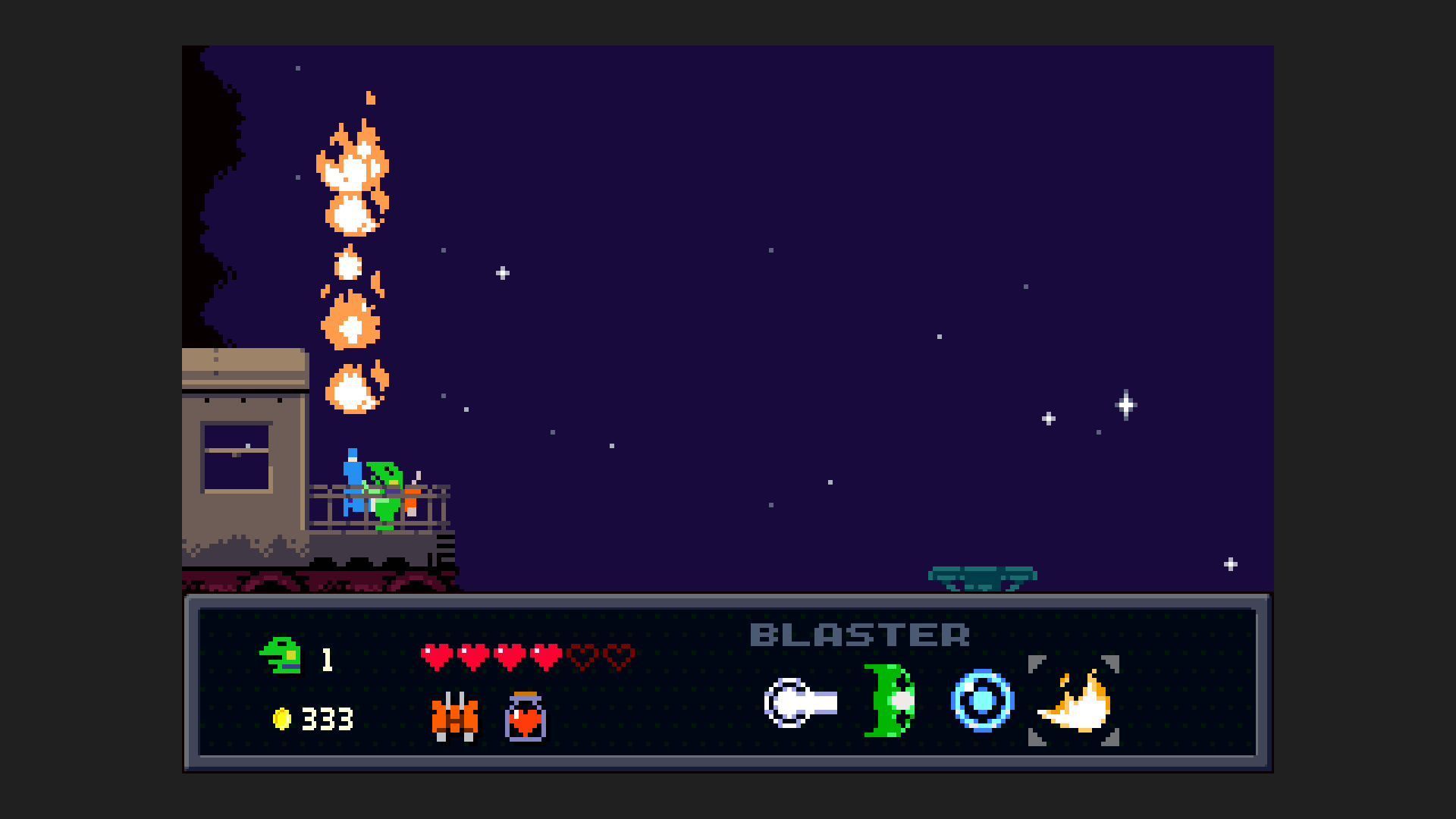
	storage. Kero Blaster brilliantly exemplifies this in many of its design elements. Promenently in is use of "[an] amphibian protagonist
	[who] shoots his way through a series of level(s), fighting bosses and collecting weapons as he goes"(Byford). In many respects, Pixel
	leverages and elaborates the difficulties in the early era game design and is helped by a willing expansion of new technological capabilities,
	to expand it sometimes simply by including "Boss fights...[that] rarely take up less than 2/3 of the screen and are inventive and challenging"(Blanchard)

	Storage space has allowed for a more compatible and elaborate level exploration that I think Pixel fairly judges
	by making the game simple enough to toy with but difficult to do so unscathed. As one reviewer put it,
	"Platforming is fairly simple, with little to no need to actually time the majority of your jumps. "
	It is clear that Daisuke reaches the same wide reaching audience as his first title did many years ago. One author writes
	"Enemies move and attack in learnable predictable ways " (FENLON). echoing another whom states "Weapons are satisfying to use, sound
	effects accompanying their firing and impacts"(SCITYDREAMER). All of which culminate in the intended message game design is known for.
	"[A] retro feel in its design, right down the pixelated graphics and chiptune music" (The_nmac).

	So before you buy this game, remember:
	"Don't waste your time grinding in easier levels, as the payouts won't be as nice" (Meo).
Citations
drinkrust. "i swear i'm not crazy,Kero Blaster's story is incredible." Medium, , , , Medium, Aug 7, 2022, https://medium.com/@drinkrust/i-swear-im-not-crazy-kero-blaster-s-story-is-incredible-119aed365949.
ETHAN. "Kero Blaster Developer Daisuke "Pixel" Amaya On How The Game Was Made." Siliconera, , , , Siliconera, June 8, 2014, https://www.siliconera.com/kero-blaster-developer-daisuke-pixel-amaya-game-made/
IGGY. "Kero Blaster Interview With Daisuke "Pixel" Amaya." 1PRINT GAMES, , , , 1PRINT GAMES, January 29, 2020, https://1printgames.com/kero-blaster-interview-with-daisuke-pixel-amaya/
Elisha Deogracias. "Suprisingly sweet -- Kero Blaster review." GAMINGREND, , , , GAMINGTREND, February 06, 2025, https://gamingtrend.com/reviews/surprisingly-sweet-kero-blaster-review/
Tracey. "[PS4] Kero Blaster Review." PS4BLOG, , , , PS4BLOG, May 4, 2017, https://www.ps4blog.net/2017/05/ps4-kero-blaster-review/
Sam Byford. "'Kero Blaster' is 'Mega Man' for the iPhone age." The Verge, , , , The Verge, May 29, 2014, https://www.theverge.com/2014/5/29/5757704/kero-blaster-review
John Blanchard. "Kero Blaster." thisismyjoystick, , , , thisismyjoystick, June 5, 2014, https://thisismyjoystick.com/reviews/kero-blaster/
The_nmac. "[Beyond Playstation] Kero Blaster Review." PS4BLOG, , , , PS4BLOG.NET, September 3, 2018, https://www.ps4blog.net/2018/09/beyond-playstation-kero-blaster-review/
Francesco De Meo. "Kero Blaster Tips and Tricks." Touch Tap Play, , , , touchtapplay.com, May 24, 2014, https://www.touchtapplay.com/kero-blaster-tips-and-tricks/
Wes Fenlon. "KERO BLASTER REVIEW." PCGAMER, , , , PCGAMER.COM, June 3, 2014, https://www.pcgamer.com/kero-blaster-review/
SCITYDREAMER. "Kero Blaster." Indie Hell Zone, , , , indehellzone.com, March 29, 2018, https://www.pcgamer.com/kero-blaster-review/